

The Arecibo Message
Trying to make contact with the intelligent life-form you used to know
I once heard a beautiful metaphor about what it’s like to witness the process of dying which has stuck with me, although I can’t find a source to credit. It’s like standing on a shore watching a boat as it sails out to sea, appearing smaller and smaller until it finally disappears into the horizon. The boat—our loved one—slips beyond our sight, perhaps to reach another shore or perhaps to sail an eternal ocean. The point is that the seeming disappearance is a trick of perspective: we are left behind on shore, ignorant of what the boat knows.
I’ve been privileged to sit with a few people in their final weeks and days, and I know that neither of my parents is near that stage of active dying. We know that Alzheimer’s and related dementias are life-limiting conditions: a diseased brain will eventually fail to command the heart to beat, the lungs to breathe. Many victims die of something else before it reaches that stage, and I would call that a mercy.
Nonetheless, Mom and Dad drift farther and farther from their old selves—and from the reality I cohabited with them—with each passing day. The image of the sailboat gradually drifting toward the horizon feels apt for this slow death, too. Sometimes you can still make contact using the ship-to-shore radio. But the transmission is crackly, and your comms fail much of the time. You do your best to figure out the coordinates of their location with simple observations.
At his best, when Dad’s more or less oriented and able to manage language, his speech is slow and slurred, a monotone. He might build a proper sentence but insert words that don’t fit: “That’s how we spent six, five get-goods” (years?). “There was a big price river” (difference?). You can almost see the whir of the processor as his mind seeks the right word, fails to find it, and takes a different route to get around the obstacle (missing a noun? Then substitute a different noun). It’s a heroic act of crisis navigation, in its way.
Unlike him, Mom still recalls names, and her speaking voice still sparkles. But for at least a year now, she’s had episodes of behaving completely out of character with her old self. Just a few days after their reunion, for example, she calmly told a visitor she and Dad had gotten divorced ages ago and then she married someone else! Said she’d come down here to help him in the hospital because she owed him that, as the father of her children.
She couldn’t be shaken from this conviction, although the next day it was all forgotten and she was back to watching nature shows on the TV in his room. (We guessed that he hadn’t recognized her on a visit, and her bruised psyche bandaged itself with this elaborate divorce story.)
Reminiscence therapy is very big in the dementia-care world. It’s standard advice to redirect a confused patient by showing them old photographs, encouraging them to tell stories about things they do remember. Naturally we packed family photos to bring from their old house, as well as a few of their dozens of albums and scrapbooks. Each of their separate rooms at the memory care is seeded with sentimental items intended to trigger a feeling of at-homeness and familiarity. Two of her little porcelain bunnies; one of his intricately handmade model circus wagons. Her Ginny doll; his wooden push-puppet dog—relics from their midcentury childhoods.
Honestly, though, I’m not sure reminiscence therapy is all it’s cracked up to be, and some of the research is skeptical too. For every time I’ve been thrilled by a spark of recognition (here’s that elephant photo from our father-daughter safari trip!), it seems like ten other such things have failed to elicit any enthusiasm or to improve the mood in the room.
I’m not the only one seeking more robust advice than reminiscing over photographs. “The Forgetting” was the first dementia podcast I listened to. It’s one of the many formats that former journalist Greg O’Brien, who has been living with early-onset Alzheimer’s for over a decade, has chosen to document the experience from within: to broadcast to the rest of us from the disappearing boat.
As the title of his memoir On Pluto indicates, he compares the breakdown of his own brain to an unwilling drift into outer space: “Pluto’s orbit, like Alzheimer’s, is chaotic; its tiny size makes it sensitve to immeasurably small particles of the solar system; hard-to-predict factors will gradually disrupt its orbit.” Like all of Greg’s brave work, the book ends with a plea to “try to fathom their journey”: “go there with them at times to Pluto.”
Maybe my reminiscence props and prompts aren’t going far enough.
As I child I was deeply impressed by the launch of the Voyager spacecraft (“messengers,” NASA calls them), each carrying their precious golden LP of the planet’s greatest hits, and I cried middle-aged tears when they left the solar system many years later.
I loved the romance of these fragile hunks of metal trying to make contact with other, hypothetical intelligences in the cosmos, in spite of the vanishingly small odds. I loved that Voyager would continue calling into space on behalf of us as a species, calling with our Peruvian panpipes and the voice of Blind Willie Johnson, just in case someone is out there.
Hello? Where are you? Who are you? Do you understand humpback whalesong? How about ancient Akkadian?
Likewise we as individuals keep calling, trying to make contact with the higher intelligence we feel must still be “in there”—inside the body whose well-encased brain is gradually, invisibly, breaking down. Take a look at this photo from when you two went to New Zealand: dressed in lifejackets and ready to raft that river!
To show up for someone with dementia is to keep sending out probes, even when the hope of a response seems slender. But it also means tuning in for those messages they may be trying to send. The Arecibo telescope, built into a big scoop of earth on an idyllic setting in Puerto Rico, was mostly used for watching and listening to cosmic objects, not talking to them.
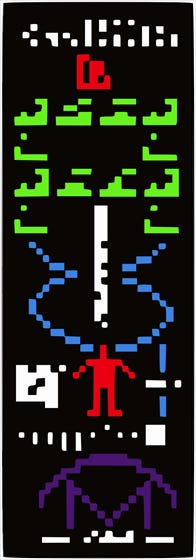
Unlike the two Voyagers—physical objects with no particular destination—the 1974 radio broadcast known as the Arecibo Message was aimed at a specific corner of our own galaxy: to M13, a star cluster visible to the naked eye. Along with the rest of Puerto Rico, the telescope was worn down by hurricanes, earthquakes, and chronic underfunding, and it collapsed in 2020. It lives on in memory and in the message, which also represents the dish shape of the transmitter itself.
Like other projects involved in the Search for Extra-Terrestrial Intelligence (SETI), the Arecibo Message is very human-centered (it encodes our DNA and an outdated stat of our planetary numbers), but also selfless in a certain way. The people who accomplished its sending knew they’d never benefit directly from any knowledge gained from it.
What a contrast to the venal, self-absorbed, bizarrely powerful billionaire who brags today about colonizing Mars. That vision is about imposing (his warped sense of) the human onto other planets and other beings, rather than trying to listen for, with, and to them. His plans nakedly benefit his own businesses and those of his political cronies, including the murderous autocrat who has Russia under his thumb. Meanwhile, his DOGE minions have slashed $65 billion in funds for research on Alzheimer’s and other dementias.
It would be poetic justice if Musk ended up on Pluto instead of Mars.
P.S. April 5 mobilization, and ¡Viva Puerto Rico libre!
Meeting them where they are is a skill I learn and relearn as Ma cycle back and forth. My heart goes out to you having both your parents suffer with this at the same time. I hope you have, I'm sure you must, have support for yourself. I posted this recently. You should have been on that list. https://substack.com/@onlythejodi/note/c-103813810
I love the metaphor of us waving and watching from the shore, and sending messages in whatever way we can think of: VHF radio, texts, ship-to-shore, even notes in bottles.
The "sending out" messages versus "listening for' them aspect you highlighted calls for a profound shift in intention that seems to reflect a societal need as well.
Another thought, as a sailor: someone leaving shore on a boat sees the land for longer than those on the beach will see the boat.